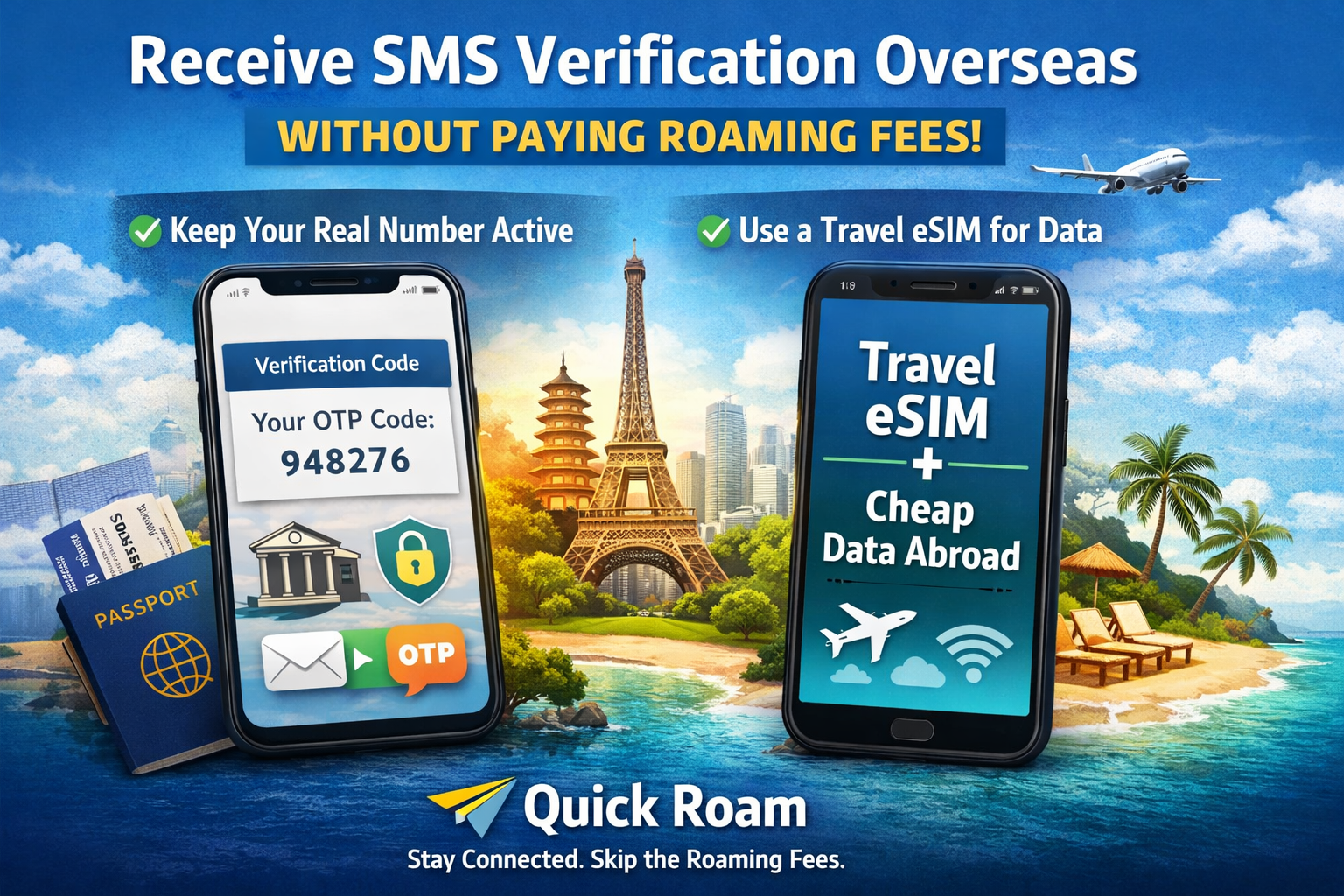
If you’ve ever traveled and suddenly couldn’t access your accounts, you’re not alone.
You land overseas, connect to WiFi, open your banking app or email, and then it happens:
“We detected a login from a new location. Enter the SMS verification code.”
That code gets sent to your real phone number back home. But if roaming is off, you won’t receive it. If roaming is on, you can get hit with roaming fees, even if you don’t use data.
This problem is one of the biggest reasons people keep buying expensive international roaming plans.
But here’s the truth:
✅ You can usually keep receiving verification SMS messages
✅ Keep your real number active for security logins
✅ And still use cheap travel data with a travel eSIM
✅ Without paying roaming for data
Why this happens (and why it’s so common)
Banks, crypto exchanges, social apps, and email providers use “risk detection.”
When they see your login coming from Spain, Croatia, Thailand, or anywhere outside your usual country, they assume:
- the account might be compromised
- you’re being hacked
- or the SIM has been swapped
So they force 2FA via SMS, especially if you haven’t set up an authenticator app.
The problem with roaming
Roaming is basically your home carrier “renting” service from a foreign carrier.
It is convenient, but expensive.
Typical roaming traps:
- data roaming fees (the biggest one)
- accidental background data usage
- answering a roaming call (even briefly) triggers charges
- outgoing SMS triggers charges
The smarter solution: Travel eSIM for data + keep your home SIM active for SMS
This is the method experienced travelers use.
Step 1: Install a travel eSIM for data (Quick Roam)
A travel eSIM gives you:
- fast local-like data rates
- cheaper plans than roaming
- instant activation without SIM swapping
Quick Roam gives you access to affordable data so you can travel without paying $15/day roaming fees.
Step 2: Keep your home SIM turned on only for incoming SMS
Here’s the key:
Most carriers do not charge for incoming SMS while roaming (but calls and outgoing SMS are another story).
That means you can often:
- receive verification codes
- receive bank OTP texts
- receive password reset codes
- keep iMessage tied to your number (on iPhone)
…while using your Quick Roam eSIM for data.
What to turn off (so you don’t get charged)
On iPhone or Android, your goal is:
✅ Quick Roam eSIM = cellular data
✅ Home SIM = voice and SMS only
❌ Home SIM = NO data roaming
Recommended settings
- Set Quick Roam eSIM as your default mobile data line
- Turn data roaming OFF for your home SIM
- Keep your home SIM active so it can receive texts
- Do not answer calls on your home SIM unless you know roaming call fees
Carriers where incoming SMS is often free while abroad
While policies vary, incoming SMS is commonly free with many providers.
Examples include:
- Rogers, Telus, Fido, Koodo, Freedom (Canada)
- Vodafone Idea (Vi) specifically states incoming SMS is not charged while roaming
- Many EU carriers (Vodafone, Orange, etc.) follow similar norms
The Quick Roam advantage
With Quick Roam, you can:
- travel and use affordable data instantly
- keep your real phone number active
- still receive verification SMS codes
- avoid roaming data costs entirely
This solves the biggest eSIM objection:
“What about SMS verification?”
Answer: You keep your number for texts and use the eSIM for cheap data.
Bonus: The best long-term fix (strong recommendation)
SMS is better than nothing, but it’s not the most secure 2FA method.
If possible, switch to:
- Authenticator apps (Google Authenticator, Microsoft Authenticator, Authy)
- Passkeys
- Security keys (YubiKey)
But until you convert everything, Quick Roam ensures you stay connected without paying roaming.
Carrier tip: Incoming SMS abroad is often free (for OTP verification)
Here’s a useful industry reality that most travelers don’t know until it saves them:
Many major mobile carriers allow incoming SMS abroad at no charge (or treat it as domestic), as long as service exists.
That means you can often keep your real phone number active for verification SMS codes, while using a Quick Roam travel eSIM for cheap data, without paying roaming data fees.
Important: Even if incoming SMS is free, you should still avoid:
- answering calls on your home SIM
- placing calls
- sending outgoing SMS
because those actions can trigger roaming charges depending on your plan.
Carriers with strong consistency that incoming SMS abroad is not charged
Canada
- Rogers
- Fido
- Telus
- Koodo
- Freedom Mobile
USA
- AT&T
- Verizon
- T-Mobile
India
- Vodafone Idea (Vi)
- Airtel
Europe (general)
Most major European carriers follow the same practice where inbound SMS works while roaming at no charge (but it can vary by country and plan), including:
- Vodafone (EU markets)
- Orange (EU markets)
- O2
- EE
- Three
- Deutsche Telekom (T-Mobile)
- Telefónica (Movistar, O2, etc.)
This is exactly why the best travel setup is often:
✅ Keep your home SIM active for verification texts
✅ Use Quick Roam eSIM for all data overseas
✅ Avoid roaming charges entirely